Renting a Pop-Up Camper Camping With a Roof, Without the Price Tag
Pop-up campers (also called fold-out campers or tent trailers) collapse flat for towing and expand into a surprisingly spacious sleeping space at camp. They're the cheapest camper you can rent, the easiest to tow and the closest thing to tent camping without actually sleeping on the ground.
Quick Specs
What Is a Pop-Up Camper?
A pop-up camper is a towable trailer that collapses down to about 4 feet tall for travel and cranks up to full height (6-7 feet) at the campsite. The roof lifts on a mechanical or hydraulic system. Canvas or vinyl sides fold out to create bed platforms that extend beyond the trailer body, giving you 2-3 separate sleeping areas.
When opened, a pop-up has more sleeping space than you'd expect — most models sleep 4-6 comfortably, and larger ones accommodate 8. The center section has a hard floor and walls with a dinette, a small cooktop (usually 2-burner propane) and a sink. Some nicer models include a small fridge, a heater and even an enclosed toilet area.
When collapsed, a pop-up is low-profile and aerodynamic. The tow vehicle barely notices it. Wind resistance is minimal compared to a travel trailer. And because they weigh 1,500-3,500 lbs loaded, most SUVs handle them fine. That towing ease is the pop-up's killer feature — you don't need a truck.
The trade-off: canvas walls mean you hear everything outside. Rain on the canvas is cozy. A raccoon knocking over your cooler at 3am is less so. Insulation is minimal — pop-ups work best in spring, summer and early fall. Cold-weather camping in a pop-up is miserable unless you add serious supplemental heating.
Pop-Up vs Other Towable Types
- → Pop-up vs travel trailer: Travel trailers have hard walls, better insulation and more amenities (full bathroom, full kitchen). But they weigh 2-3x more, need a bigger tow vehicle and cost $75-$200/night to rent. Pop-ups are the budget choice. Travel trailer guide.
- → Pop-up vs teardrop: Teardrops are hard-sided and weather-tight but only sleep 2. Pop-ups sleep 4-8. If you're a couple, a teardrop is tidier. If you have kids, a pop-up wins on sleeping capacity per dollar. Teardrop guide.
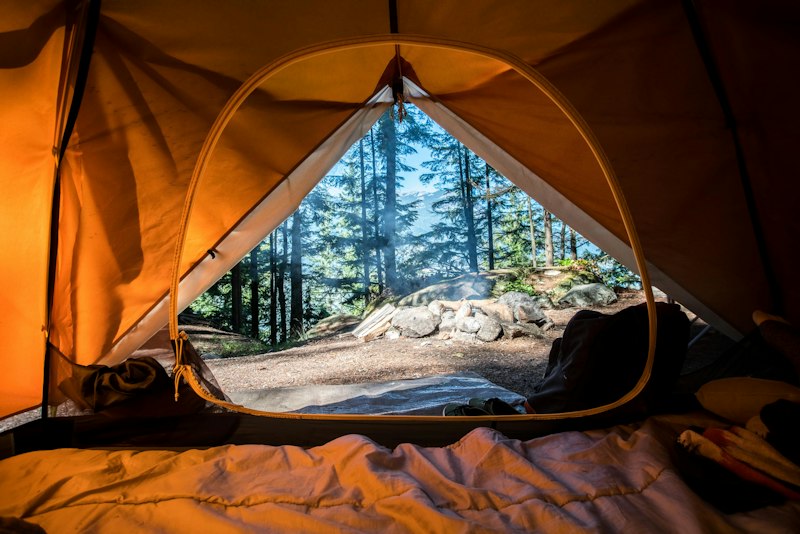
- → Pop-up vs tent: A pop-up gets you off the ground onto a real mattress, adds a kitchen area and protects from bugs. Setup is faster than a large family tent. The downside is you need a tow vehicle and a campsite that fits a trailer.
Pros and Cons
Pros
- → Cheapest camper rental ($50-$150/night)
- → Most SUVs can tow one
- → Sleeps 4-8 for the price of a hotel room
- → Low profile while towing = better fuel economy
- → Feels like camping (open-air canvas walls)
- → Fits in any campsite that takes tents
Cons
- → Canvas walls = zero insulation
- → Not weatherproof in heavy rain or wind
- → Setup/teardown takes 10-20 minutes
- → No real bathroom in most models
- → Condensation buildup on cold mornings
- → Mice and bugs can get in through canvas seams
Where to Rent a Pop-Up
Pop-ups are almost exclusively available on peer-to-peer platforms. Fleet companies don't stock them. Private owners list them on Outdoorsy and RVshare — many offer delivery to your campground so you don't even need a tow vehicle.
| Platform | Pop-Up Pricing | Notes |
|---|---|---|
| Outdoorsy | $50-$150/night | Best pop-up selection, delivery available |
| RVshare | $50-$125/night | Good inventory, some with delivery |
Delivery is popular for pop-up rentals. Owners drive the camper to your campsite, set it up and pick it up when you're done. Delivery fees run $50-$150 depending on distance.
Setup and Teardown Tips
- → Practice before the trip. Have the owner walk you through setup and teardown at pickup. Do it yourself at least once in the parking lot before you leave. The first time at a dark campsite is the wrong time to learn.
- → Level the trailer first. Before cranking up the roof, use leveling blocks under the tires and drop the stabilizer jacks. A level trailer means water drains properly and doors close correctly.
- → Check the canvas for mold. At pickup, open the camper and inspect the canvas walls and bed platforms. Musty smell or visible mold means the camper was stored wet. This is a problem — ask the owner to address it before you accept.
- → Never tow with the roof up. Sounds obvious but people do it. The canvas and frame will be destroyed at highway speed. Always crank down fully, latch everything and check that bed platforms are retracted before driving.
- → Dry the canvas before packing up. If you tear down in the rain or with morning dew, mold will grow inside within days. If you can't dry it at camp, unpack and dry the canvas within 24 hours of returning. Most owners have this in their rental agreements.
Pop-Up Camper FAQ
Can my SUV tow a pop-up?
Probably. Most mid-size and full-size SUVs tow 3,500-5,000 lbs — well above a pop-up's 1,500-3,500 lb range. Even compact SUVs like a Toyota RAV4 (3,500 lb tow capacity) handle lighter pop-ups. Check your owner's manual for your specific vehicle's towing limit and make sure it exceeds the pop-up's loaded weight.
Do pop-ups have bathrooms?
Most don't. Some higher-end models have a small enclosed area with a portable toilet and optional outdoor shower. If a bathroom matters, a travel trailer or Class C motorhome is a better fit. Plan on using campground bathhouses with a pop-up.
Are pop-ups good for rain?
Light rain is fine — the canvas sheds water and the sound is actually pleasant. Heavy sustained rain or storms can overwhelm the canvas seams and cause leaks. Strong wind combined with rain is where pop-ups struggle most. If you're camping in a region known for sudden storms, consider a hard-sided option.
Explore other camper types
Class A Motorhomes · Class B Campervans · Class C Motorhomes · Travel Trailers · Teardrop Trailers · Truck Campers